Wednesday, May 29, 2019

Cataloging of Artifacts


Cataloging of Historical Artifacts

By Daniel D. Stuhlman

Libraries collect more than just published materials.  The library collects materials that represent all kinds of human creative activity.[1]  One aspect of the collection is to gather books and materials (including electronic resources) that fill the short-term information and recreational reading needs of the patrons and another aspect is to think about the longer-term preservation of knowledge.  The longer-term needs are part of the research and historical mission of the library.  Part of the preservation task may include older books, papers, manuscripts, ephemera, and artifacts.  Many libraries collect museum or art items and some collect realia. In researching this article, I found libraries that collect educational kits, tools, items to study anatomy, tools of a trade, kits to learn or teach math, and more. I found a collection of wood samples used in the building trade to help people decide what flooring to purchase.  I also found items such as dolls and games both for recreational and study purposes.  

The Northwestern University Herskovits Library of African Studies collects objects that are connected to any aspect of Africa. Examples of objects include clothing, signs, figurines, dolls, etc.   This picture is a shelf with hats used at a soccer world cup. The items are organized in boxes on shelves, but most of them are not in the library catalog.

Avery Library of Columbia University has about 4,667 works of original art in their catalog, but the catalog has no “realia” format.  CARLI [2] (union catalog for Illinois research libraries) has many examples of 3D objects.  I didn’t find any bibliographic records in WorldCat for these realia.  Each library followed its own rules and that makes inconsistent bibliographic entries and difficulty to look up items.

The cataloging of realia (that is an object for its “thingness” rather than its intellectual content) presents challenges not quite covered in the rules of cataloging. An artifact is a sub-category of realia.  The usual definition is anything made or modified by human beings.  However, for purposes of including in a library catalog it must have a connection to a time, place and/or responsibility.  Works of art are not necessarily historical artifacts.  A work of art that is produced in multiple copies, and meant to be sold or distributed, can be cataloged similarly to a published book.  If it falls within the collection policy of the library, it will be part of the collection. For example, a non-print object connected to an event is a historical ephemeral artifact.  A fancy tzedakah box that is sold in many copies may be considered published or if connected to an event it may be a historical artifact.  

Cataloging of Kippot

This article concentrates on the cataloging of kippot as historical artifacts.  From this discussion one can generalize the cataloging of other materials. For example, other items that may be imprinted for an event. The suggestions here are strictly my personal opinion.  While based on the examination of records of many libraries, standards of library description, and based on many years of cataloging experience, no other library or librarian has approved or adopted these rules.  I use cataloger’s prerogative to create rules that best serve my library users.  If your library shares bibliographic records with OCLC or other libraries, you will have to consider their needs, too.  

Very often after events such as bar/bat mitzvah celebrations or weddings the celebrants leave kippot[3] outside of the sanctuary. While passing by and seeing the piles of practically new kippot, they seemed to call out me, “Save us!”  Since they are historical artifacts connected to the synagogue, its members and a historical event we decided to save, collect, and catalog them. The congregation is attuned to history because this is the year celebrating the 150th anniversary of its founding. 

These kippot are historical artifacts that eventually researchers can put into context and notice trends. It would have been very interesting to see how kippot changed over the years.[4]  It would be helpful for other libraries to create a collection and see if trends could be identified based on time, community or denomination[5].  The synagogue library would have no interest in collecting kippot in general. However, if we received a donation of a kippah that was connected to an historical event or representative of an historical period, we may decide to keep it as part of our general Judaica collection policy. [6]

When cataloging a book[7], the chief source of information for the bibliographic records is the title page.  Unless the publisher is a complete neophyte, the title page contains the information concerning the title and responsibility that the publisher wants potential readers, vendors, and libraries to known about the item.  In other words, how does one find the item and know this is the item is the result of the search?  I choose “artifact” as the record type.  This record type depends on your system.  You may want “realia” or even create a new type to fit your library’s needs. 

When the vendor, creator or manufacturer does not supply a chief source of information, the librarian gathers the information in a way that figures out how they sell the item.  Many of the kippot had the name of the vendor/manufacturer on a sticker or tag.  I visited the vendor websites to get information for the bibliographic records. 


A picture of the item is an important part of the bibliographic record because the other information is weak when compared to book cataloging.  Use vendor supplied pictures or take your own. For the fixed field 008, the place of publication is the same as you choose for the 264 field.  Date is the date of the event. Language code is blank and catalog source is ‘d’ for other.  Since there is no person or corporate body that is responsible, there are no entries in the MARC 100 fields. For the 245 title field use the descriptive or item title used for selling the items. If the vendor is not known, then create a title in the same style. Some libraries put the cataloger created title in square brackets. The use of brackets may depend on how your systems alphabetizes and searches for bracketed words. Measure the diameter for the size in centimeters in the 300 field. If there is an illustration on the top use $b illustration.  

If you want, add a 500 note giving the source of the title.  However, I consider that 500 note to be overkill for a small library.  A research library may require the note.  The 245 has no $b[8] sub-field as there is no sub-title and no $c for responsibility.

For 264 use the vendor or manufacturer.  When I looked up the web sites for the vendors they indicated that they had a shop where the kippot are made or assembled.  I assume the companies have a large supply of raw materials and make the kippot for each order.  If there is a broker or sales agent, it will be up to the cataloger to figure out the name of the producer.  The date is the date of the event unless there is an indication that the item was made at another time. If the item has no indication for the vendor concerning the place of publication, use [Brooklyn, New York?] or [United States] depending on any other evidence you have. Most the of US manufacturing of kippot is done in Brooklyn.  “Brooklyn” would be a good guess unless you have other evidence of a place.  For the sub-field $b leave it out or use something like “publisher unknown.”


Add a 500 general note or a 590 local note with the exact wording of the inscription inside the kippah.   For a kippah always add the subject heading 650 $a Jews $x Religious life and customs $v Head covering[9].  Since I wanted this to be a special collection I created a series, “Kippah collection.”  This series is optional, and any 440 field would have to follow your library’s practice. I debated as to how to include the celebrant of the event.  The name is very important part of the artifact nature of the item.  I debated as to whether the name should be in the 600 or 700 field.  I decided that since the celebrant had nothing to do with the creation of the item and was the central player or subject of the event, the 600 field was the best choice. If the kippah is from a wedding, decide locally if both names are included.  If the item is for a “b’nei” mitzvah event that is two celebrants[10] using the same kippah, make two 600 entries.

Since the item is an artifact you may consider making a 380 Form of Work entry.  In the pre RDA days a sub-field $h was used as the medium in the title 245 field.  This subfield is optional today.  The 33x fields are used for medium.  However, I have no advice on what to write in the 33x fields.  None of the library records I examined had the fields and the documentation from OCLC didn’t help.

For classification numbers I use “Kippah” followed by a consecutive number.  The collection is separate and there is no need for a subject classification.  I do not write or mark on the items.  I use a clip to attach a bar code and put the items in individual a plastic bag.  They are stored in an old card catalog drawer. For circulation purposes they are considered museum pieces.  They will not circulate outside of the library, but library users are welcome to examine them.

In summation, the cataloger’s goal is to enable library users the ability to look up item using the name of the celebrants, subject heading or the search term “kippah” to examine the whole collection. I hope this advice helps you to create consistent records and provide ways to systematically search for the records. Please consider this a work in progress.  If you have any ideas for refinements, please don’t hesitate to send comments.[11]

Notes:


[1] Museums and libraries both collect materials and have the overlapping goal concerning the preservation of human creative activity.  The differences between their missions is beyond the scope of this article.  When walking into a building, one would not be confused as to whether it was a museum or library.


[2] Consortium of Academic and Research Libraries in Illinois.  CARLI serves 94% of Illinois higher education students and have 130 members.  https://www.carli.illinois.edu/
 

[3] While searching libraries for examples of kippot, I came across several articles that had “kippah” in the title but were in the subject area of chemistry.  For example: “Controlling sol–gel polymerization to create bowl-shaped polysilsesquioxane particles with a kippah structure” in the journal Polymer, Volume 54, Issue 10, 26 April 2013, Pages 2493-2497, talks about bowl-shaped particles with a kippah structure.
When I use “kippah” or the plural “kippot” I refer to the ritual head cap used by Jews in worship. Catholic clergy use a head covering that looks like a kippah, called zucchettos, but our library would not collect them.   In modern Hebrew כיפה has a more generic meaning.  It can mean any special dome-like coving such as in Kipat Ha-selah (Dome of the Rock).   For more discussion on Jewish head gear see my two articles in Librarian’s Lobby: “The Yarmulke : part 1 Etymology of the term” and  “The Yarmulke : part 2 Head Gear in General.” 


[4] This is a Reform congregation and probably there was a time in its history kippot were either forbidden or the use was frowned upon.  


[5] With the few that I collected so far, I found none with writing, symbols or designs on the top (outside).  In Orthodox synagogues I have seen many kippot with writing or messages on the top.  Some even have imitation sports symbols. In my personal collection, I have one kippah that had the corporate symbol of the non-Jewish organization that I worked for that was given to me by my supervisor. I considered it part of my work clothes.  


[6] In the “The Yarmulke: part 1” mentioned above there is a picture on the last page showing men wearing two distinct types of kippot.  I would collect those for the library because of the historical value.


[7] Cataloging rules for non-print materials such as recordings have different places for the chief source of information.


[8] Also called delimiters.


[9] If you are adding kippot that are from the general community, don’t hesitate to substitute the appropriate religious group in place of “Jews.” You may want to add the place of the event if you think your library users will benefit from the added entry.


[10] Such as two siblings.


[11] I thank the people who helped me with ideas and read earlier versions even though that does not make this quite “peer-reviewed.”

Home page: stuhlman.info


Tuesday, February 12, 2019

Visiting Libraries in Israel 2019


Visiting Libraries in Israel 2019


Six years ago, August 2012, I visited three research libraries in Israel.  On my trip this year (Dec. 31, 2018 – January 13, 2019) I wanted to visit libraries again.  I am not one who wanted to do the usual in Israel or hear from a tour guide for two weeks.  I visited the National Library, University of Haifa, Schechter Institute and CDI Systems.  I visited the National Library and the University of Haifa on the last visit.  I also visited museums as a professional development activity because I make exhibits in my library and I want to see how they present materials.
In December, many weeks before my trip I posted a message to the Hasfran discussion group.  I got several replies.

The National Library of Israel  הספרייה הלאמית  

On Dec. 31 I went to The National Library and met with Ahava Cohen and several of her colleagues.  Ahava is the head of the Hebrew cataloging department and they also do Arabic. The National Library was established in 1892 to collect works dealing with the intellectual heritage of the Jewish people.  In 1925 when the Hebrew University was founded, and the campus was located on Mount Scopus, the library severed both the University and as the national library. After 1948 when access to Mount Scopus was not allowed the Library had many homes until the opening of the Givat Ram campus in 1960. In July 2008 the university and national library separated into two libraries.  The Jewish National and University Library became the National Library of Israel.  The National Library’s master plan is building a new 45,000 square meter building near the Knesset and is scheduled for completion in 2020.  The $200 million project is being paid for by the Israeli government and private donations.

As a national library their mission is to collect, catalog, organize and preserve every kind of print, digital, or non-print media related to the land and state of Israel and most materials concerning Jews from the rest of the world.  The copyright law of Israel requires deposit of two copies of every work.  One copy is kept in the main library stacks and the other is sent for preservation to a remote storage area.in the north. Collecting digital media is a particular challenge.  Automatic collection is done for web pages with “il” as part of their address.  Israeli companies that use “com” as a domain are harder to keep track of.  Sometimes they need a little help. 

The Library also collects e-books. Partly they depend on publishers and authors to send copies to the Library. I have a friend who works for an Israeli think tank, Jerusalem Center for Public Affairs (http://jcpa.org/). They prepare books, smaller publications, and videos in Hebrew and English that are only published in electronic formats.  Most of the e-documents were not in the National Library catalog.  I helped get them together.

My meeting was very productive.  I learned about some of the challenges of a National Library that don’t exist in an academic library.  The National Library is responsible for name, subject and title authority at a level to set the example for other libraries.  This is similar to the role of the Library of Congress.  Because they set the example and they frequently do the original cataloging for Israeli materials, it takes them longer than other libraries to catalog an item.  While they try to collect everything, ephemera is hard to collect.  Materials such as museum catalogs, theater programs, school publications, and guidebooks attractions are hard to collect.  Since they are not usually submitted for copyright registration the Library depends on organizations to send them materials.  They are so good with their processing that their backlog fits in one book case.  They have fewer items waiting for cataloging than my personal collection.

As a national library they are a member of a group of European national libraries. They have regular audio conferences to discuss mutual issues.  They wanted the Egyptian National Library to take care of Arabic name authorities.  The Israel Library bluffed.  They said if you don’t do it, we will.  The Egyptians agreed to do the Arabic authority work and share the files with the other libraries.

Under the rules of AACR2 and RDA authors need a unique identity.  If an author has the same name as a second author, the cataloger differentiates them. One of the ways is to use dates of birth and death (if deceased.)  If this information is not known from public sources or copyright application, the library staff tries to contact the author.  Sometimes if the dates are not known, an occupation is used.  Ahava told me that sometimes cousins have the same name and occupation. Then the Library has to use the father’s name (ben plony) as part of the name authority. I never heard of this way of differentializing author names in American cataloging.
I also talked to the cataloger for children’s literature about my project concerning children’s literature during the first half of the 20th century.  In the catalog we found a bibliography of German Jewish children’s literature[1] that we ordered from the stacks. I retrieved the book from the Judaica studies reading room.  The furniture and reading desks look the same today as 1970 when I was a student.  I was not able to read any of the actual German books because of time constraints and they didn’t fit my criteria of examining America Jewish children’s literature, but it was helpful to know books do exist. However, it seems there were more German Jewish children’s books published than those in English.

The National Library has a coordinated exhibit, Maimonides - There was None Like Moses, on Rambam with the Israel Museum.  The Library has printed books written by Rambam and the printing press in this picture.  The online version is here: http://rambam.nli.org.il/en. [2] The Israel Museum has artifacts such as a manuscript on his Mishnah Torah with Rambam’s autograph attesting to accuracy of the copy. This is the kind of coordination that I have been just able to do in my college library this school year. The Library and Museum can feature items that are part of their expertise and the publicity can hit different audiences. Each audience hears about the other institution.  In my college library I work with other departments.

In summary it was interesting and informative visit to learn and share information with the librarians at The National Library. They have a mission that overlaps academic research libraries, but also has responsibilities to the library world and nation that academic libraries don’t have.   Hopefully, on a future trip I can see the new building and learn how the new building is affects their mission.

University of Haifa Library - אוניברסיטת חיפה


The University of Haifa was founded in 1963 to operate under the academic supervision of the Hebrew University of Jerusalem, and became an independent institution in 1972.  It is one of eight major Israeli public universities[3]. Located on Mount Carmel the outstanding feature is a thirty-story classroom and office tower.  The first picture below is a view looking north from six years ago. The second was taken on January 1, 2019.  It would take expert photo analysis to figure out the differences between the pictures (other than the shadow of the tower and the clouds.)


The University has a diverse student population including international students who study in English, secular and religious Jews, Christian and Muslim Arabs, and Druze. In additional to excellence in the sciences, humanities, social sciences, law, education, medicine, they have a maritime research program.  Part of their mission is to foster academic excellence in an atmosphere of tolerance and multiculturalism.[4]

I took the train from Jerusalem because I wanted ride the new high-speed train and I like trains better than buses because the ride is smoother and faster.  On the last visit I had to stand all the way home because the bus was crowded. None of the young soldiers would give up a seat for an “old man.”

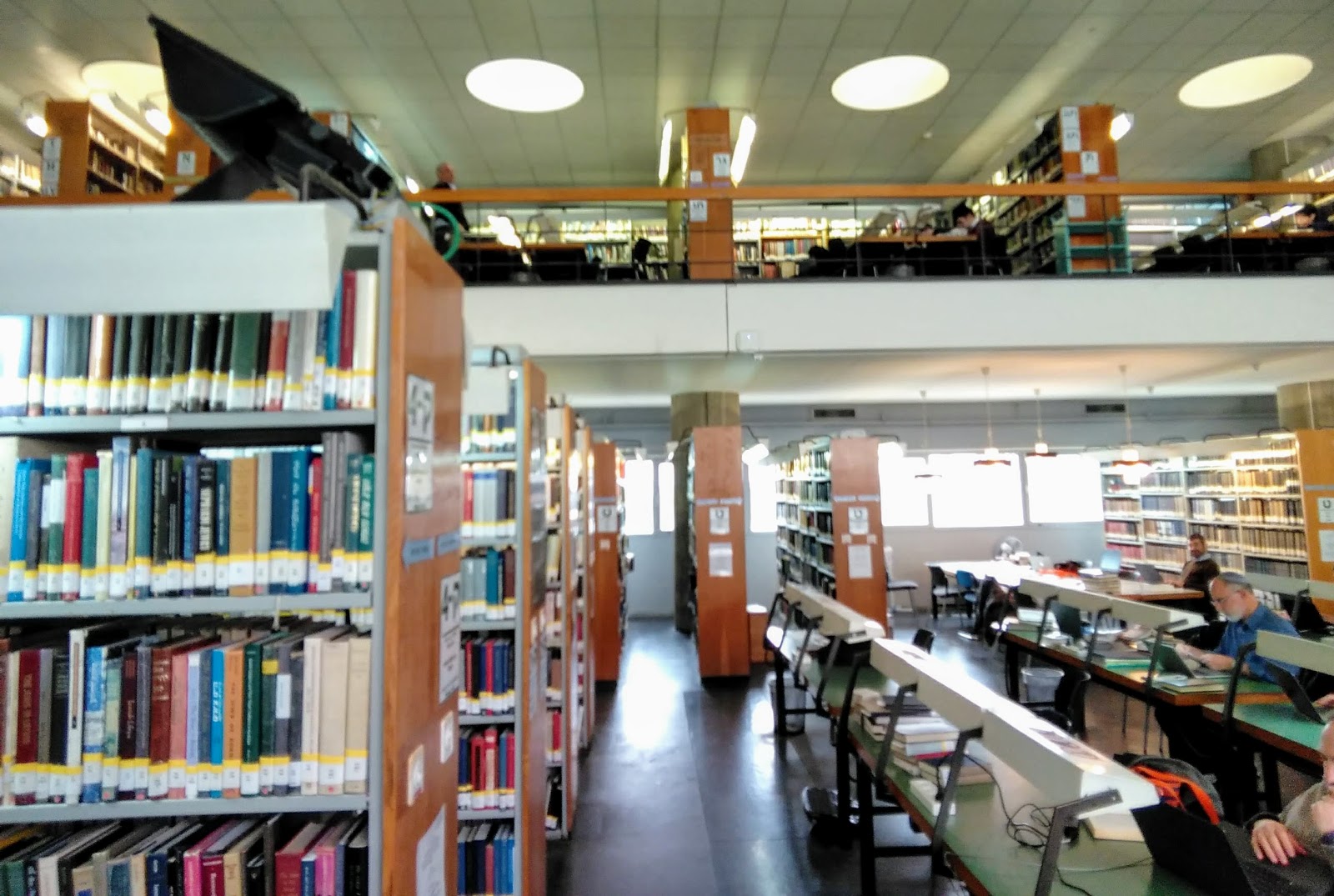
I met with Yosef Bronse, Yardena Levenberg, and Sharon Glaubach who all work cataloging and technical services.  I met with Yosef on the previous visit six years ago however the others who I met with have retired. Most of our conversation centered on comparing how they process materials.  I told them about my visit to the National Library on the previous day.  One very impressive feature of their infrastructure is they have their own IT department.  The department solely works with the library, not like at my college where the IT people are in another office or building.  Six years ago, I was very impressed with the study rooms that students or faculty could book.  Now my library has them and it is a marvelous tool that encourages collaboration. I was very impressed with the main reading room which also has the reference and circulation desks. The stacks also have study desks and some comfortable chairs.

Here are two pictures of two different areas of the stacks.


While they said they don’t do much in the area of exhibits, I saw some posters in the corridor that was outside of the Library but one could look into the stacked area.  One of the people in the pictures, Professor Irun Cohen is the son of someone who was a member (who has passed away) of my shul in Chicago. Professor Cohen is professor emeritus, an immunologist at the Weizmann Institute of Science.

Reference desk
The Library has a collection of Hebrew children’s books to support the education programs.  The collection is mostly contemporary works. The library is only open three hours per day on Mondays, Tuesdays and Thursdays.   Because of my interest in historical children’s books, we checked for woks written before 1948.  They had next to none since they purposely collect recent materials.  Even though they have more than 5000 books, it is not a collection of historical children’s literature.

On campus is the Hecht Museum of archeology (http://mushecht.haifa.ac.il Click here).The
exhibits include Temple Mount excavations, ancient peoples who lived in Eretz Israel before the Bible, ancient crafts to produce everyday objects, and in a separate section French and Jewish paintings are displayed. One exhibit in on the history of the alphabet.  This is of special interest to librarians. There a few paintings from famous artists such as Van Gogh, Monet, and Modigliani. This is a small museum in the administration building. Admission is free, and they open at 10 am daily and have variable closing times.[5] There were very few visitors when I was there.  I assume those affiliated with the university think the museum is so normal they don’t visit very often.

The visit to the campus and the meetings with the librarians was very useful.  Most of the conversations were not on a level that is easily summarized in an article. While I was impressed with the number of staff and expertise they have, they did report that budgets are tight.  The Library is open 8:00 am - 6:00 pm because of budget restrictions.

Schechter Institute of Jewish Studies   למדעי היהדות מכון שכטר

The Schechter Institute (http://www.schechter.edu/  )is a small school of about 600 students with their Jerusalem campus in the Nayot neighborhood near the Israel Museum. They are affiliated with the Conservative Movement and their mission is to connect Israelis with Jewish heritage while nurturing the values of tolerance, pluralism, learning, and dialog.

Their library has a staff of two, Shaya Fishman and  Esther Blatman,  who both met with me.  The collection has more than 30,000 volumes of mostly Judaica (that is Jewish history, Bible, rabbinics,  commentaries, and literature) and Hebraica spread out over several rooms.  The main stack area is also the reading room and staff office. Decades ago this room was the beit midrash and beit knesset for students studying in Israel from Jewish Theological Seminary. [6]Some of the rooms were once offices.  They have a large collection of periodical back issues that contains many treasures not easily found in other libraries.  The library rare book room, which is in a locked room that is also the bomb shelter, has treasures more than 200 years old. I could smell mold as soon as I entered the room.  The room needs a dehumidifier to protect the books from mold and deterioration.

Esther and Shaya had a list of questions for me concerning issues of cataloging and library operations. The library catalog’s web site is:
http://infocenters.co.il/schechter/ .  The library is not part of the Israel Union Catalog (ULI), which means if you will have to check their catalog directly to view the holdings.


They want to make sure their catalog follows national standards such as Library of Congress classification and current standards of descriptive cataloging. They also want to make the collection more relevant to the current faculty and student needs. (This  is a never ending task for academic and school libraries.) I shared some of what I learned at the National Library and much from my experience. After many years of experience some aspects of librarianship are just automatic with me. Some classification numbers I have memorized.  (Of course there are many that I have to look up.) I was able to help them with several kinds of solutions to make their catalog better.  I told them about some of my work with electronic exhibits and outreach.  Shaya, a recent hire is very attuned to social media and web sites.  He is a recent graduate of Bar Ilan University and he learned a lot about use of electronic resources for library operations, outreach, and communications. Education to be a librarian today is much different than when I was in school or even 11 years ago when I taught library school courses. As someone who grew up using computers, Shaya has a different perspective on them than I do.


CDI Systems


The last of my visits was to CDI Systems (https://www.cdisys.com) where I met with Itzhak Levit (CEO of the company)  They are a software company that designs and develops databases used by libraries worldwide, including an ecommerce system for book distribution.  You may say they furnish the brains so that librarians can gather and share bibliographic information and content.  I never really talked to a vendor who supplied the wisdom for me to do my work.  CDI Systems is located in Jerusalem’s high-tech industrial park, Beck Science Center Har Hotzvim.  The buildings do not look like Jerusalem buildings.  They could be located in suburban areas of any American city. Many companies are small and some are the among the world giants such as Cisco and Mobileye[7].

CDI Systems’  customers include book publishers in many disciplines, universities, law offices, and book vendors. They have offices in  Europe and China. Recently they launched www.peterbooks.com/en[8], a platform for the sale of print on demand, print and digital books. The Bar-Ilan Online Responsa project is also their product.  This project is the world’s largest collection of Torah literature and responsa. CDI products in the Jewish domain include The Bibliography of the Hebrew Book, Cotar, Institute of Talmudic Research, The Holocaust Responsa and more.  Judaica librarians know about these databases, but the company behind them is less known.  I learned about their business and model and products.  I gave them a few suggestions of where they may seek new customers.  Of concern to libraries is how publishers deal with digital rights. CDI Systems solution includes also their own Digital Rights Management proprietary technology, thus offering publishers a solution to protect the usage of their electronic publications (intellectual content) and limit it to authorized users only. Vendors (publishers and their agents) can sell digital copies without concern about unauthorized distribution. For example a library will purchase an e-book.  Digital Right Management will allow the library to lend electronic copies to authorized users.   My college library is not a potential customer because we have no Jewish studies, but a rabbinical or Jewish scholarly organization may be able to subscribe to the Judaica databases for their members.

Summary


I visited places that very connected to world beyond Israel.  While the National Library has national interests as a major mission, as a national library they have connections to libraries worldwide.  Bibliographic records created by the National Library are available via WorldCat to libraries around the world. Decisions made concerning Hebrew cataloging affect other libraries that catalog in Hebrew.  The University of Haifa is a model of diversity and their library reflects this in their collection building.  They are a tri-lingual (Hebrew, Arabic and English) operation where Jews and non-Jews, Israelis and foreigners learn. The Schechter Institute is much smaller in their academic reach.  However,  since they are named after one of my academic heroes, they have a special place in my universe.

CDI  Systems as a for profit company is totally on a different financial model than government agencies and academic institutions, but they are dependent on them for their living.  They seek excellence in ways that colleges and universities cannot.  They also can reach out to East Asia and Europe in ways that non-profit Israeli institutions cannot.  While the news media would have viewers and readers believe Israeli society is full of clashes, there are companies that just want to help society and  make money in the process, universities that want to teach the next generation of scholars and citizens, and a national library that wants to make sure human knowledge is gathered, saved and shared. All of these places that I visited want to spread knowledge.  With knowledge comes truth and with truth comes a better appreciation of the world around us.[9]


[1]  Jüdisches Kinderleben im Spiegel jüdischer Kinderbücher : eine Austellung der Universitätsbibliothek Oldenburg mit dem Kindheitsmuseum Marburg / herausgegeben von Helge-Ulrike Hyams [and others]. Oldenburg : Bibliotheks- und Informationsssystem der Universität Oldenburg, 1998.  This book is the "Catalog for the 17th Exhibition of the University Library as part of the Oldenburg Children and Youth Book Fair 1998 in the Stadtmuseum Oldenburg ..."

[2] A joint web page for the exhibit.

[3] Weizmann Institute of Science is one of the eight, but it is only a graduate institute, not a comprehensive university.  Ariel University, founded in 1982, is the youngest institution. Israel has 40 colleges that primarily award undergraduate degrees and 26 teacher training colleges  that primarily award bachelors  of education degrees.  Four American colleges  have campuses in Israel.

[4] This multiculturalism is evidenced even in the Israeli cinema. In the 2006 film, The Syrian bride =  ha-Kalah ha-Surit written by Eran Rilkis, the sister of the title character wanted to study social work at the University of Haifa.  She had to overcome family objections and limited Hebrew abilities to succeed.

[5] They close at 1 pm on Fridays but are open on Shabbat. Many museums even in Jerusalem are open on Shabbat.

[6] In school year 1970-71 I spent many hours studying Talmud there.  However, I have no memory or pictures of what the room looked like then.

[7] Mobileye is owned by Intel.

[8] The Peter Books site is in Spanish and English and is based in Spain.

[9] A draft of this document was offered to the organizations that I visited.  I made changes based on the comments received.  It was also reviewed by the dean of my college, who oversees the library. 

Last revised Feb 14, 2019.  

Wednesday, January 30, 2019

People of Jerusalem 2019


People of Jerusalem
January 30, 2019

From December 30, 2018 to January 13, 2019 I visited Israel.  This was just a normal vacation, not a “trip of a lifetime.”  I wanted to visit people and places that I was both familiar with and not.  I didn’t go on a tour bus with a tour guide or even behave like a tourist.  I just made my own plans.  Before I left, I arranged visits to libraries to meet with librarians.  That will be a separate report.  This article will just cover some of the people I encountered in my travels.  Please take these as amusing or interesting people.  I don’t mean to “make fun” or demean anyone.

To start I present a picture of myself -- while I’m not a wild and crazy guy, I am not shy.  Here I am standing next to the Kotel. No matter how many times I visit, no matter how much I learn about the excavations, no matter how much history I read about Jerusalem, I am still moved by just being there.  When I was growing up, the Jordanians didn’t let Jews visit.  I thought we would never be able to be there.  Then the Six Day War came, and we heard, “the Kotel is ours.”  Even though most of the stones are from Herod and after, the connection to the original Temple can still be found everywhere.  Some excavations even found the remains of burnt wood from the destruction.

The Kotel is place of contrasts. Here is a picture of me and the next picture is a man looking on his cell phone with people praying in the background. Tourists, residents, and Israelis from all over flock there. In addition to the majesty of the wall itself, on can enter the tunnel and be part of a regular or ad hoc prayer group.  This is picture of places for prayer with an aron hakodesh to hold Torah scrolls. The Western Wall Foundation has walking and virtual tours for the public to see areas not available to the unaccompanied public.


One can see people from all over the world.  The groups from such as Japan, China, and Africa can be seen intently listening to the words of their guides. Tourists who speak English or Hebrew don’t seem to pay as close attention. That is not all members of the group are listening at a given moment.  I saw several groups of blacks wearing the same green hats and backpack with the logo of the tour or travel agency.  Some of the group wore outfits made from the same cloth that was brightly colored in patterns that no one outside their group would ever wear.  The styles of the clothes were not the same.   I later learned that tour operators provided the cloth.  I talked with one of the tourists who told me he was Nigeria.  He took a selfie with me.

One evening the Kotel was full of soldiers and their families.  The soldiers were there for their basic training graduation.  I didn’t see the ceremony, but I saw the preparations and people walking to the Kotel.  Other days I saw bar or bat mitzvah ceremonies.  At one time, musicians played as the family went to the Kotel.  The residents of the Jewish Quarter complained about the noise and commotion and now the processions are quieter and avoid being near homes where people live.

I got very familiar with Jaffa Gate (שער יפו.)  One day I was proud to help an Israeli who asked in Hebrew where is the Jaffa Gate.  I just pointed and said ישער (straight ahead).  Another day I was startled when an Arab businessman asked in German, “Wie Gehts?”  I just couldn’t spit out the proper response, “Es geht mir gut.”  I was only able answer in Hebrew.

The #38 bus serves the Jewish Quarter with an 18-passenger bus.  The route is circular route that starts and end at the same stop.  I never ceased to be amused when the announcement at the end reminded everyone to take their belongings and thanked everyone for choosing Egged. (As if we had another choice.)  Egged is not the only bus company, but there is no competition on individual routes. Most of the time riding that bus was like riding with friends. A man with a heavy accent asked his neighbor in Hebrew-Yiddish, איך אומרים וואסר?  (How do you say “water?”)  This in heavily accented English, he asked, “Does anyone have water?  My daughter needs water.”  Right away two people offered a bottle of water.  He paused then replied, “Do you have a cup?” The daughter didn’t seem to really need the water.  It seemed like a comedy routine from 40 or 50 years ago.

While waiting for the #38 bus near City Hall, a woman with two shopping carts asked in English, “Which direction is the Kotel?”  I pointed her in the right direction I surmised was correct based on the city walls.  She took out her ArtScroll siddur and started reading a prayer in English.  When the bus came she struggled to get on. When we got on the bus, the person next to me said that he was familiar with her.

When I went to the Israel Museum I saw a tour scheduled for the Judaica collection at 12:30 and decided to take it.  I was the only one who showed up and so I had a personal tour.  There is an exhibit of life cycle events with wedding dresses from Jews in Arab countries. They are very colorful.  The tour guide said that Queen Victoria was the style setter for white wedding gowns.  I had no idea that she could cause such a revolution.  I thought the only clothes she influenced was the wearing of neck ties because she though shirt buttons reminded her of belly buttons.  Of course, I had to check.  The tour of guide was right.  Before Queen Victoria brides dressed in colors or even blacks and grays.

The next picture is the Shrine of the Book on the grounds of the Israel Museum.  This is building houses the story and documents of the Dead Sea scrolls.  Once it held the Isaiah scroll, but now it features a replica.  This very quiet place[1] is a shrine to the whole concept of a book, writing and history connected to what makes us a literate civilization. People connected to books, readers, librarians, students, scholars, etc. should visit and be impressed and humbled at how far communications has advanced.  We can still read writing that was done 2000 or more years ago.


My cousin, the tour guide, told me to visit the Gush Katif Museum (http://en.gushkatifmuseum.com/) .  Gush Katif was the Israeli settlement area of the Gaza Strip. In August 2005 the Israeli army carried out the government orders to remove all settlers and bull doze the homes and institutions of the settlements. About 8,600 residents lived there who were mostly religious Zionists, but also included some secular Jews and several hundred Bedouins. Most of the economy was based on agriculture.  Many had lived there more than 20 years. They had advanced technology greenhouses to raise pest-free vegetables. Exports to Europe were over $60 million a year according to what the museum stated.  The museum is on a small street, Sha’are Zedek in a remodeled apartment. It is a little hard to find.  For most of my visit I was the only one there.  The guide/caretaker was very friendly and helpful.  He told me about the exhibits and settlements.  This was a very sad place to visit.  I saw a video about the expulsion that showed lots of people crying.  Residents did not want to leave. This is a place to learn about a sad time in history, not a place for fun.  The guide said that few if any former Gush Katif residents live in the Jerusalem area. The museum is a place to remember the people and places they lived.

Here is a picture of the Gush Katif street sign and the bus stop.


Signs claim Kikar Zion (Zion Square) is place for street entertainment and food.  Twice I went to restaurants there for a meal.   Here is a picture of street musician.  She had a violin and recorded accompaniment.  There are two car batteries under her feet to supply power to her amplifier.  While a passerby wanted a selfie with her, I took this picture of both. This was January and so they are dressed for the weather. At other times I saw dance groups and other musicians.  They all come well prepared. 

Most of the people I saw were very nice and polite.  When I asked for directions people were helpful and when I was able to help people were appreciative.  I had to visit the office of Rav-Kav to get a bus pass.  Another customer was English speaking and the clerks needed help to get him to understand.  I helped.  On a bus some tourists who didn’t know Hebrew couldn’t understand the bus driver.  He yelled, “Mi midabar anglit?” (“Anyone speak English?”)  Before I could react, the person in the first seat behind the driver spoke up and helped.

When I visited the National Library some high school students were taking a survey.  They asked me questions about Trump and his policies.  I really had no idea of what to say. I had no opinion on the topics they questioned. On a bus to Beter Illit there were no seats left.  A man put his youngster on his lap so that I had a place to sit.  When using the Israel Railways[2] there were lots of employees helping people navigate the station and get to the right place.

The parts of Jerusalem that I visited were very busy with cars, trucks, pedestrians, buses, etc.  It is much more congested than my quiet Chicago neighborhood[3]. In Israel one feels part of history and a great big family; in Chicago one feels that the city is just a place that we live.


[1] Talking is limited here.

[2] Before going to Israel, I wanted to ride the high-speed train between Jerusalem and Ben Gurion Airport.  The train is beautiful, and ride is smooth and fast.  One hardly hears the sound of the tracks.  We need such great service in Chicago. Given a choice between a train and bus, I always choose the train.

[3] “Congestion” is relative. Jerusalem has about 875,000 residents and probably more than 100,00 visitors. The average population density for Jerusalem is about 19,000 people per square mile.  For my neighborhood of Chicago with about 72,000 residents in 3.53 sp. miles, the population density is 20,632 per square mile.  For all of Chicago the density is 11.602 persons per square mile.