Sunday, June 21, 2020

Rare Book Mystery

Librarian's Lobby December 1997, Daniel D. Stuhlman

Librarian's Lobby
by Daniel D. Stuhlman

 December 1997

A Rare Book Mystery

Detective work involves going from the known to find the unknown. One job of a librarian is to solve mysteries. A few weeks ago one of our faculty members, Dr. Abe Lipshitz, handed me a book and asked, "What is the title of this book?" This book had a blank cover, a missing title page, and the pages for the table of contents were cut in half. The book had no running title or clues to the author. I looked at the book and immediately knew it was an 18th century book. Dr. Lipshitz found this book on the regular shelves, not in the special closed stack section for old books. My curiosity was aroused and I had to find out the name of this book.

I asked him how he found the book. He said that he had a reference to a book of drashot, but the reference didn't have a title or author. He was looking on the shelves and had a feeling that he found the book. The reference gave a page and this book was the right one. Dr. Lipshitz wanted to quote the book for an article he was writing and needed my help to find the author and title

The copy of the book had a recent binding with the title, Darkhei Noam, handwritten on the spine and inside the cover. The first step was to check this title in Bet Eked Sefarim . The title, Darkhei Noam, had several entries. None of them matched our item.

From internal evidence, the book was written by a Sephardi rabbi and published in 1753. He was living in the year 1700. It was not known if he was alive or not when the book was printed. The book has 168 pages long and measured 28 cm. It contains sermons according to the weekly parasha and some for special occasions such as a yahrtzeit.

I checked via the Internet the libraries of Jewish Theological Seminary, Brandeis University, Library of Congress, Hebrew University, and Bar Ilan University and OCLC First Search None of them had a book that matched. I concluded that the title was not Darkhei Noam. I then did another series of searches by date for all Hebrew titles published in 1753.

After searching all those libraries for books published in 1753, I still didn't find the book.

It was time to turn to my fellow librarians for help. I turned to a friend who is a rare book librarian for Judaica and Hebraica at Emory University. I sent him an e-mail. He gave me some suggestions. He recommended that I check the University of Pennsylvania I did not know they had an on-line catalog. One librarian in the Boston area gave the name of a book, but it was not correct.

Finally the curator of rare books and manuscripts Bar Ilan University, Dr. Sara Fraenkel, offered to help. She had a CD ROM called The Bibliography of the Hebrew Book, 1470 - 1960. It has more books than Bet Eked and can be searched by date in addition to author or title. She identified the book and offered to send a photocopy of the missing title page. It is called Yad Moshe, by Hayyim Moses ben Solomon Amarillo (ca. 1678-1748). It was published in Salonika. Bar Ilan owns two copies.

Amarillo has an entry in the Encyclopedia Judaica ( vol. 2 col 792) which has different birthdate (1695). This date does not make sense since one of the sermons in Yad Moshe was dated 1700. Amarillo was born in Salonika and studied with his father, Solomon (1645-1721), who was one of the chief rabbis of Salonika. Hayyim Moses filled many posts in Salonika until 1724 when he fled a plague and went to Constantinople. Amarillo was appointed one of three chief rabbis and was a prolific writer.

After getting the information, I was able to use OCLC First Search® to find the cataloging information. The book was reprinted in 1990 on microfiche from the Harvard University Library copy.

The major Jewish libraries mentioned above have publicly available on-line catalogs that can be searched on the Internet. I learned a great deal about searching for books by date. While the libraries do a good job of cataloging their current collection, older books may not be in the catalog. Also the older books may have been entered using a previous version of cataloging rules.

At lunch a faculty member asked me what I do at the computer. I said, " Catalog books." He asked if I get bored. I answered, "For me, cataloging is exciting every minute." Books are our link to the past. They contain the frozen thoughts of the authors just waiting for us to thaw out and assimilate into our minds. Each book gives us clues to the time and place it was written and affects each reader differently. As a librarian, I act as a guide to the sea of knowledge.

I just love it when I solve a good mystery.


Notes

1. OCLC FirstSearch has a data base called WorldCat which has the cataloging records of several hundred libraries from around the world.
2. The Center for Judaic Studies, University of Pennsylvania in Philadelphia is the former The Annenberg Research Institute, which used to be Dropsie University and Dropsie College.

3. Bet Eked Sefarim, by Bernhard (Hayyim Dov) Friedberg, is a standard bibliography of books in Hebrew and other languages in Hebrew character published from 1450 - 1956. The first edition, published in Antwerp in 1928, contained about 26,000 entries. A second edition appeared in 1961 and contained about 50,000 entries. (It is hard to imagine the care he had to take in the days before computers.)

4. The Bibliography of the Hebrew Book, 1470 - 1960 from The Institute for Hebrew Bibliography. Sponsored by : The Hebrew University of Jerusalem, The Bialik Institute, and The Israel Ministry of Education and Culture is a bibliography of all printed Hebrew language books before 1960. It contains over 90,000 titles and 12,000 authors. It is published on CD -ROM. For now only books in the Hebrew language are recorded. Yiddish and other languages using Hebrew letters will be added later. This is a massive project that has been going on for over 30 years. The HTC Library does not yet own this work.

5. The Israeli university libraries, JTS, Ohio State, and U. of Penn use a system called ALEPH. This system, from an Israeli company, is a powerful library management system that can catalog and offer public access to books in Latin, Hebrew, Arabic and Cyrillic characters. The systems used by Library of Congress, and OCLC enter Hebrew books in transliteration only. Brandeis's system over the Web is in transliteration only. Their local system displays Hebrew characters.

6. Thanks to all the librarians who answered my questions and helped me learn more about rare Hebrew books.
©2001 Last revised March 23, 2001

Jewish Community of St.Louis

Librarian's Lobby August 1997 Zion in the Valley : the Jewish community of St.Louis, by Walter Ehrlich

Librarian's Lobby
by Daniel D. Stuhlman
 
August 1997

 The Jewish Community of St.Louis

This is a picture of my great-grandmother Celia Vogel holding me in her left hand and my cousin Howard on her right. On August 15-17 I went to St. Louis to for a family reunion of my mother's cousins--the decedents of Abraham and Celia Vogel (My mother's maternal grandparents). We had about 48 family units with about 130 cousins attending. It is amazing that Baba and Zeda managed with 6 children and one on the way to settle in St. Louis.


One of my tasks for the reunion was to prepare a speech to put the family history in an historical perspective. I had many months to prepare for the speech. I wanted to find information on the history of Jews in St. Louis and about Falticeni, Romania where my great-grandparents emigrated from. I searched the library catalogs for books about St. Louis and Romania without success. I searched other library catalogs without success. I searched encyclopedias, but found little useful information. There didn't seem to be any general histories on St. Louis or Romania.

About two weeks before the reunion I searched the Web using the terms, "Jews, St.Louis and history." I found one book, Zion in the Valley : the Jewish community of St.Louis, by Walter Ehrlich published by the University of Missouri Press in April 1997. I quickly tried to find the book. No local library owned it. I ordered the book from our supplier and received it 3 days before my speech. The first of three volumes covers the period of 1807-1907. (The other volumes have not yet been published.) This included the year 1897 when my Zeda arrived in the US and 1903 when they arrived in St.Louis.

Walter Ehrlich, who was raised in an Orthodox Jewish home in St. Louis, is professor emeritus of history at the University of Missouri--St.Louis. He was always interested in American Jewish history, but his graduate school mentors dissuaded him. He was encouraged to study history on a more national scope. He went into the field of constitutional history and eventually wrote and published important books and papers in that area.

Why did he write about St. Louis Jewish history? I found out the answer before I ever heard of his book -- No one had ever done it before. This was surprising since I easily found histories of New Orleans, Indianapolis, Kansas City and Columbus, Ohio all smaller cities with smaller Jewish populations than St. Louis.

In some ways St. Louis was a microcosm of the American Jewish community. There was the tension between the established Jews with German backgrounds and the Eastern European immigrants; and between the Reform and Orthodox. There were some crossovers. For example there was a German Orthodox congregation and Russian Reform congregation.

St. Louis had a long history of active Zionism that included all factions of the community. Groups such as Rishon le Zion Lodge, Dorchai Zion, Daughters of Zion, Poalei Zion, Ahavath Zion, Ha-Achooza and B'nai Zion were active. They represented different Zionist philosophies. In 1905 Simon Goldman founded the St. Louis Zionist Council to better co-ordinate Zionist activities in St. Louis.

Like most histories, Zion in the Valley centers on the movers and shakers of the community. I was looking for what the every day life of a Jews was in St.Louis. I am still looking for descriptions or even fictional accounts of everyday Jewish life in St.Louis.

Another thread to explore was documentation about my family. I had family recollections, but I wanted some documentation. My great-grandparents were not movers and shakers. They were not listed in the American Jewish Year Books or in Ehrlich's book. We have not yet found out the names of our great-grandparents' parents. We have not been able to find out the names of their sibling. One way to find out such information is to read their Social Security records. I looked them up in the Social Security Death Index. The names were not there. That means they probably did not have Social Security cards and no one collected a death benefit. We tried to find their immigration records and were not successful.

We do have a lot of documentation on our current family that includes a family directory and a list of the family tree that includes birth, marriage and death dates. We still have a lot of research to do our family history and the history of communities we come from.

The HTC Library is frequently a source for researchers to find out about their family. Last week a reader was partly successful. He was researching the Karrol family and had traced his genealogy back to a 13th century paytan named Abshalom Kara. We found an entry in an encyclopedia of rabbis. The entry gave a short biography and included the text found on his grave stone in Prague.

August 11, 2011 Note: Since this was written we have found many names of ancestors and cousins. Zeda Abraham's parents were: Aizic and Pesa Feigler. I am not sure when he changed his family name to Vogel, but it was before he left Romania. Baba Celia's parents were: Herscu and Hantza Rosenthal.

We have fewer names for my father's side of the family. My father claims to have never known the names of his grandparents. Only recently did I discover their names, Yisrael & Raizel Stuhlman; Yecheal & Surah Schrager.


Reference Works for Biblical Studies

Librarian's Lobby November 1997 -- Current Library exhibit

Librarian's Lobby
by Daniel D. Stuhlman
November 1997

Reference Works for Biblical Studies

The current Library exhibit is in honor of the 75th anniversary of the Hebrew Theological College. The exhibit includes books and articles by and about faculty and staff and memorabilia from early faculty and supporters of HTC. One interesting item is the etrog box given to Rabbi Chaim David Regensberg when he retired in 1971. This exhibit continues until the end of December. In January the Library will have an exhibit in honor of the 50th anniversary of Israel.

This month I would like to discuss a specialized Hebrew dictionary used when studying, Tanach, A Hebrew and English Lexicon of the Old Testament, by Francis Brown with the cooperation of S. R. Driver and Charles A. Briggs. (It is referred to by the initials of its authors BDB.) The first edition was published in 1907 by Oxford University Press and reprinted with minor corrections at least seven times. This lexicon is based on the lexicon of William Gesenius which first appeared in German in 1833 and last revised in 1854.

BDB is important because each contains the English translation, an etymology, and quotes or examples from the Bible text. The etymology uses the Semitic languages that the authors knew, Arabic, Aramaic, Assyrian, Ethiopic, Phoenician, Syrian, and others. Absent is Ugaritic, which is very close to Hebrew, because Ugaritic was rediscovered after the book was originally published. Ugaritic was a language, written on clay tablets in cuneiform script, used in in the second millennium B.C.E. Some of the Ugaritic prose and poetry is parallel to biblical texts. BDB includes explanations of all the words in the Bible including proper names. The Aramaic words in the Bible are in a special section in the back of the book. This is a valuable reference book, but it is somewhat dated in its style of entry and because it is missing over 90 years of Biblical and ancient Near Eastern studies.

For example the entry for Daniel illustrates some of the strengths and weaknesses of BDB.

If you look up you will referred to the root. The first abbreviation means this is a male proper name. The meaning explained, with a reference to H. Ewald's Hebrew Grammar, is El is my judge. It is connected to the (an ancient Persian language)word wise or wisdom. The body of the definition explains the Biblical characters named Daniel and gives the Greek form of the name. The name, Daniel, appears in the Ugaritic text, The Tale of Aqhat. James Pritchard in The Ancient Near East says that Daniel in Ugarit means God judges.

Before the days of computer data bases of Jewish sources concordances were the only way to find all occurrences of words in the Talmud. Otsar Lashon ha-Talmud [Thesaurus Talmudis, confecit Chaim Josua Kasowski] lists all the words in the Talmud with a Hebrew definition. This first volume of this reference work was published by the Israel Ministry of Education in 1954. Volume 41 was published in 1982 after the death of the Rabbi Kasowski.

This work is very easy to use. The main entry is root word such as av or tkn After each root word is a definition, then each form of the word is listed with every place in the Talmud where the word appears. When required for clarification the words are vocalized. The listing includes a phrase or sentence to put the word into context. This work is a gold mine of information that is not used very often. Sometimes using this concordance can be faster than using the computer to search a CD-ROM data base. It is amazing that it does not get more use.

The Encyclopedia Talmudica is the English version of the Encyclopedia Talmudit It is a digest of halakhic literature and literature form the Tannaic period to the present time. The English volumes are translations of the Hebrew volumes, that means the title of the entry is in Hebrew. The first volume covers the first part of the letter Aleph. The project, which was started in 1947 by Rabbi Meyer Berlin and Rabbi Shlomo Josef Zevin, is still not complete. The Hebrew version is on volume 22.

The English volume has a table of contents in English and Hebrew in the order of the Hebrew topics. A second listing is in English alphabetic order.

This is an encyclopedia of Halacha. For example the first article on the letter Aleph contains information about the use of the Aleph in a name for a get. The article Elan [Tree] gives the halakhic definition of tree. A tree is distinguished from a herb, bush, or grass

This encyclopedia is a gold mine, but limited because it is not complete and bibliographic references are limited to a few sources in the Tanach and Talmud.

1997 AJL Cleveland Convention

Librarian's Lobby for July 1997 AJL Cleveland Convention
Librarian's Lobby
by Daniel D. Stuhlman

July 1997

 
AJL Cleveland Convention

Every June for the past 32 years Jewish librarians have been gathering for the annual Association of Jewish Libraries (AJL) convention. This year AJL met in Cleveland on June 22-25 with the theme, "Shared space -- real and virtual : the Jewish library and the world." One question from the convention floor concerning publicity prompts me to tell about some of the exciting activities in libraries and Jewish studies.

The last speaker at the convention was Charles A. Ratner, president and CEO of Forest City Enterprises, Inc. in Cleveland. Ratner started out by saying that before he was asked to give a speech for AJL he had never heard of the organization and never knew what a librarian did. After this opening, his talk covered his struggle to get a Jewish education for his children and how he journeyed from a parent to a community activist then to a leader for Jewish education. In the question and answer period, one librarian asked, "How can we publicize what the Cleveland Federation is doing?"

Mr. Ratner said that 15 years ago the Federation made a strategic plan for the community. The portion concerning education said that since only 14% of Jewish students attend day schools they want to concentrate their efforts on the supplemental schools. They wanted to encourage congregational schools to teach children. Rabbis and educators wanted to teach Jews how to feel Jewish and better about themselves. Ratner, continued by saying, thank God no one listened to that report. Since the strategic plan was made three new day schools have been opened, new buildings built, and enrollment is now 28% of the Jewish student population. Millions of Federation dollars have been spent to build buildings and train teachers to staff those schools. Millions have been spent on improving the educational content of the school programs.

Part of this improvement in education infrastructure was explained by Dr. David Ariel told us about the programs of Cleveland College of Jewish Studies to train teachers at the highest levels, including masters and doctoral degrees and distance learning programs..

Ratner told us what kinds of education didn't work. Events, retreats and classes based on feeling Jewish didn't work. Text-based classes and events did work. When students learned a text they went home with something they could hold and build upon.

Now for my personal thoughts -- What role does a librarian have in a Jewish school, congregation or yeshiva? As my son told me, "Abba isn't everyone at the Yeshiva your student?" Librarians are the professionals who control the purchase, cataloging, storage, and retrieval of the texts. Librarians organize and classify information to enable readers to find information when they need it. Think of the two greatest discoveries of Hebrew texts in this century, the Cairo Geniza and Dead Sea Scrolls. How much easier our work would be if these collections were cataloged libraries instead of the piles of paper and parchment that we found. When one starts to include commentaries, Halacha, history, science, philosophy, literature and every other subjects needed to be an informed person, the size of the collection needed skyrockets.

Arlene Rich of the Cleveland Jewish Genealogy Society led a session on genealogy resources.. She told us some beautiful stories of families who found lost relatives as a result of looking into their family histories. She gave us lists of reference works for libraries to own and let us use the Social Security Death Benefit CD-ROM to look up names. From this session librarians learned not only what resources are available, but of the importance of saving records for future generations. [Note: The HTC Library collects banquet books, year books, and wedding books, which can be used by future readers for family research.]

Dr. Daniel Rettberg of Pitts Theological Library, Emory University gave a paper on manuscript books from Yemen. The Yemenite Jews used manuscript books into the 20th century. Dr. Rettberg showed slides of two manuscripts, one was done by a professional scribe and the other by a non-professional for personal use. Books and paper were so scarce the margins of the books were used for practicing Hebrew writing. Printed books came very late to Yemen, partly because of Moslem conservatism. The government didn't want large numbers of literate people. Jews did import a few Hebrew books because they were less threatening than Arabic books.

Dr. Menachem Schmelzer, provost of Jewish Theological Seminary and former JTS librarian, delivered a fascinating lecture on the American contribution to Genizah studies. He told of the history of the documents and where the documents are today. He talked about some of the prominent scholars including S.D. Goitein. (One of the librarians in the audience said that she was related to Goitein and verified everything the Dr. Schmelzer said.) I was able to talk to Dr. Schmelzer privately about some research he is doing on a medieval manuscript that relates to work one of the HTC faculty is doing.

In addition to the 32 sessions with opportunities to learn, meals and exhibits presented a wonderful time to meet librarians and discuss their libraries. I finally met in person many of the people I correspond with via e-mail and phone. I met the editors from the Ofek Institute who are working with two of our faculty members. The opportunity to share knowledge and resources is a very important component of the convention. The contacts I made will help me better serve my readers.

The 175 librarians who attended the convention included teacher-librarians from day schools, Judaica librarians in universities, librarian-managers of large libraries, librarians in synagogues, schools and Jewish centers, and researchers. Their jobs include catalogers, reference librarians, managers, acquisition librarians, archivists, historians, library automation experts, rare book librarians, and internet gurus. Librarians are the collectors, guardians, catalogers, organizers, guides and disseminators of the recorded word in any media imagined. While books and periodicals are prominent media in today's collections, librarians need to collect and learn more about the electronic and non-print media. The libraries of the future will contain materials in electronic format including cd-roms and computer files. Computers not only help us to produce materials faster, more accurately, but also move the information to those who need it much faster.

Thursday, June 11, 2020

Story of the Two Brothers – Revisited

[Note June 11, 2020 --> This is here for historical purposes only.]

The Story of the Two Brothers – Revisited
By Daniel D. Stuhlman
May 31, 2012
 
Let me retell the story—

King Solomon wanted to find a place build the Temple. A heavenly voice directed him from Mount Zion to a field that was once owned by two brothers. One of the brothers was a bachelor and the other was blessed with a wife and children. After the harvest each brother was concerned about the other. Under the cover of night the father kept adding to his brother's pile because he reasoned because he thought the bachelor had no children to support him in his old age. The bachelor added to the father's pile because he thought that with so many children his brother needed more grain. The brothers met in the middle of the field and embraced. This field, a manifestation of brotherly love, King Solomon reasoned this was best site for the Temple.[1]

In 1997, before Google searches and the wide-spread of digitization out-of-print, a faculty member came into the library with a question about the source of the story about two brothers.  He was very learned in Talmud and other rabbinic sources, but his couldn’t find the source of the story.  He said that the story is so old that it must be from the rabbis. He thought that he remembered it from the Talmud, but couldn't quite remember the source. He wanted my help to find the source.

This article is both an update to the original and an examination of sources I didn’t have available then. 

The 1997 article is one of my most popular because it illustrates how people use stories without understanding their origins. I have referred people to this article because the Two Brothers story is so widely known.  In a recent rabbi’s sermon, the rabbi presented this story as if it was an old Jewish story.  Indeed it is a great example of familial love, honor and respect and how a place can have the honor of commemorate that story. The use of stories is an important part of speeches and sermons.  However, one can not represent a story for something it is not.

If a story is written as a parable to illustrate a point and if you claim the story has ancient, royal roots, it adds credence.   For example at the Yom Tov dinner table one guest told a story about a king who had a daughter who was so special that she was not allowed to have any contact with men before her wedding day. It took a long time for the king to find a groom who would marry the daughter without ever meeting her.  People at the table kept interrupting the storyteller saying, “That is terrible!”  “How can the king be so mean?”  The people listening were impatient.  The story was a parable.  It never happened, but was created to illustrate a point.  The king found a groom.  After the couple got to know each other, the groom asked for another wedding celebration, because at the first one he couldn’t fully understand the love of his life.  If the people listening to the story would have been patient, they would have learned the point to the story was that love is learned and does not happen by accident.

This story of brotherly love contrasts to the stories of brotherly rivalry such as the stories of: Cain and Abel, Yitzhak and Ishmael, Ya’akov and Esau, and Joseph and his brothers.  A story of brotherly love is rare.  There is a 2300 year old Egyptian tale of two brothers; the younger, conscientious one is accused by his older brother of a proposal of adultery against his wife.[2]

The story of the two brothers sounds like it is very old because it mentions King Solomon. (Remember royal and ancient add credence.) Since the events seemingly happened in Biblical times, one should first check the Bible.  The story is not in the Bible.  Since the story happened hundreds of years before the Talmud, one would next reason that the story should be found in the Talmud, Midrash, or other rabbinic literature.

A search of the Talmud and Midrash found nothing. We tried Hebrew and English terms such as “two brothers,” “Temple of Solomon,” and Beit Mikdash but found nothing. We wanted to verify the story to be sure that we weren't imagining the story. We tried Bialik's Sefer HaAgadah[3] and Micha Joseph Bin Gorion's Mimekor Yisrael. [4]

Micha Joseph Bin Gorion retells the story as, “A story of the Temple.”   There are no comments or notes. This story was hard to find because the title does not mention “two brothers.”

We looked in the index of The legends of the Jews by Louis Ginzberg (1873-1953). The story is found on page 154 of volume 4. Ginzberg quotes Israel Costa in Mikweh Israel,[5] no. 59 which says that Berthold Auerbach refers to this legend in his [Black Forest] Village Stories[6]. Ginzberg further speculates that the author may have been drawing upon an oral tradition from the Jews of Russia or Germany. The legend seems to be a midrashic exposition of Psalm 133:1 (How good and how pleasant that brothers dwell together.). Ginzberg is not sure of the source. I was unable to verify the reference that Ginzberg made to Black Forest Village Stories, however I found another reference in a book about Berthold Auerbach[7] (1812-1882)  written by Anton Bettelheim (1851-1930.)   He remembers his mother (died 1852) telling him the story saying that she learned if from a rabbi who was her father’s neighbor.

In Zev Vilnay's Legends of Jerusalem on page 77, he says that Israel Kosta (Mikwah Israel, 1851) relates a story of the two brothers. Vilnay says the legend first appears in the description of travels by Alphonse de Lamartine, Voyage en Orient, I, 1875.[8]

Both Vilnay and Ginzberg are unsure of the exact origin of the legend. The story is definitely not from Biblical or Rabbinic times. It may be a variant on a Russian or French non-Jewish legend.
Compare this to the evidence in Tanakh (Bible). In II Chronicles 3:1 it says that Solomon built the Temple on Mount Moriah, which was revealed to David. Moriah is connected to Akedat Yitzhak (sacrifice of Isaac). Midrash Tehilim connects Adam and Noah to Mount Moriah. The site had kedushah [holiness] long before the time of King Solomon. This conflicts with the legend of two brothers. [9]

Here are some additional published versions of the story.

Glass, Meredith A.  A tale of two brothers: a retelling of a Jewish folktale for young children.  New York, Bank Street College of Education, 1998.

Hebrew folklore from sidrach stories / edited by Steven M. Rosman. New York, UAHC Press, 1989 p. 19-20.
Smith, Cris, One city, two brothers. Cambridge, MA, Barefoot Books, 2007.

 “A tale of two brothers” in Stories Seldom Told: Biblical stories retold for children & adults / by Lois Miriam Wilson. Wood Lake Publishing Inc., 1997 p 55-56.  

“The two brothers” in The World Over story book / edited by Norton Belth.  New York, Bloch Publishing Company, c1952 p. 10-12. 

The answer to the bibliographic quest is the legend is not rabbinic and even goes against Biblical and rabbinic evidence. There is no recorded evidence of the story before 1835, however, by the time Ginzberg wrote his Legends of the Jews the story was well known. There is weak evidence that the legend is from Russian Jewish sources. We also learn that bibliographic references must be verified since Ginzberg and Vilnay made mistakes recording the titles of books. This is not the final word on the source of the legend because I have not yet located any sources of similar French, Russian or German legends. From this quest we learn that we should be careful about what we call ancient, Biblical, Talmudic or rabbinic.


[1] This is an abbreviated version; fuller versions are listed later in this article.

[2] The Ancient Near East: An Anthology of Texts and Pictures / edited by  James Bennett Pritchard, Daniel E. Fleming.  Princeton, NJ, Princeton University Press, 2010 p. 11.  (Page 12 in the 1958 edition.)  The British Museum web site has a summary of the story.   British Museum site has a picture of the papyrus scroll with the story : http://www.britishmuseum.org/explore/highlights/highlight_objects/aes/s/sheet_from_the_tale_of_two_bro.aspx

[3] Full reference:  Bialik, Ḥayyim Naḥman. ספר האגדה : מבחר האגדות שבתלמוד ובמדרשים == Sefer ha’Agadah : mivḥar ha’agadot shebi-Talmud. vibamidrashim.  Tel Aviv, Diver, 1967 (and other dates)  English translation: The book of legends : sefer ha-aggadah : legends from the Talmud and Midrash   New York : Schocken Books,  1992.

[4] Mimekor Yisrael : classical Jewish folktales. Bloomington, IN, Indiana University Press, 1976.  Vol. 1 page 491-492, no. 270.

[5] Vilnay spells the name as “Kosta”.  Full reference: Costa, Israel.  Sefer Mikveh Yisrael : ve-hu sefer sipure musar le-ḥanekh et ha-nearim …  Livorno : Belforte, 1851.

[6] The book has several stories about brothers.  In one story the brothers are feuding over the estate of their mother.  They reconcile and live in peace on harmony the rest of their lives.  In another the brothers always helped each other.  In the last scene of the story the majesty of God’s glory descends on them.

[7]  Bettelheim, Anton, Berthold Auerbach; der Mann, sein Werk, sein Nachlass.  Stuttgart, Cotta, 1907 p. 13-14.  May be read on the Internet  Archive:  http://archive.org/details/bertholdauerbac00bettgoog

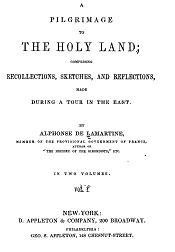
[8] Vilnay says that the story is on page 329 of the 1875 edition, but I was unable to locate this edition.  The book is a report of an 1832 journey that included the land of Israel, first published in 1935. I found via the Internet Archive (http://archive.org/details/apilgrimagetoho00lamagoog)  an 1848 English translation published by D. Appleton and Company.  Front CoverThe title page is the picture at the beginning of this article. After the story de Lamartine comments on page 284:
 What a lovely tradition! How it breathes the unaffected benevolance of patriarchal morals! How simple, primival  and natural is the inspiration leading men to consecrate to God a spot  on which virtue has germinated  upon earth!  I  have heard heard among the Arabs a hundred of such legends. The air of the Bible is breathed  in all parts of this East.

This was a widely circulated book in both the original French and translations.  Note that the story is identified as Arab, not Jewish.

[9] In Studies in Jewish and World Folklore by Haim Schwartzbaum (Berlin, Walter DeGruyter, 1968)  on page 462 are listed more source.  Schwartzbaum says that the story appeared in the Arabic book of legends, Kalib wa-Dimnah in the prologue attributed to Abdallah ibn Al-Muqaffa (died circa 760).   I was not able to find an English translation of this book online or in an accessible library.